Richard Bingham continues the “Shoreham Unlisted” series by looking at the architecture of one of Shoreham’s Victorian schools.
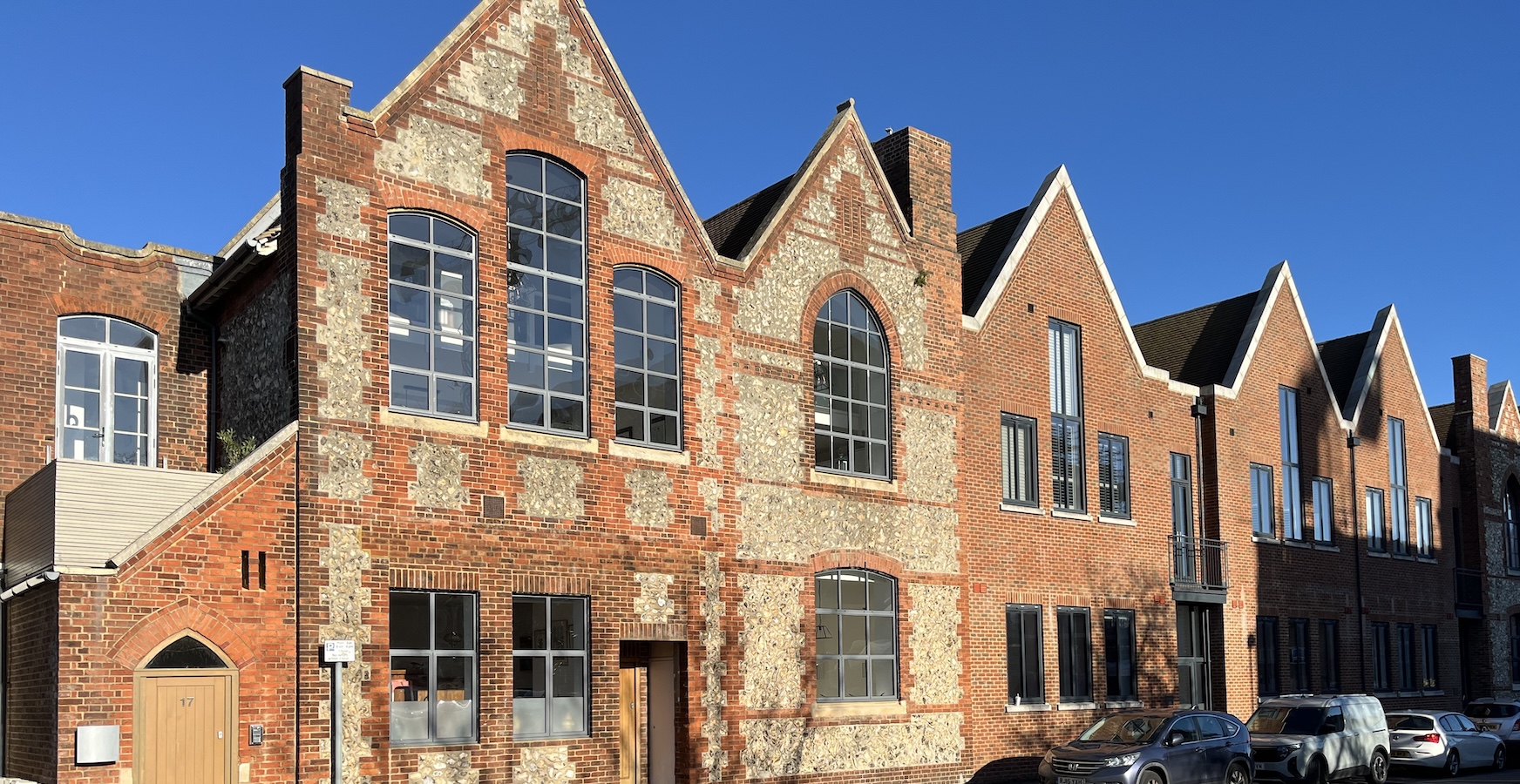
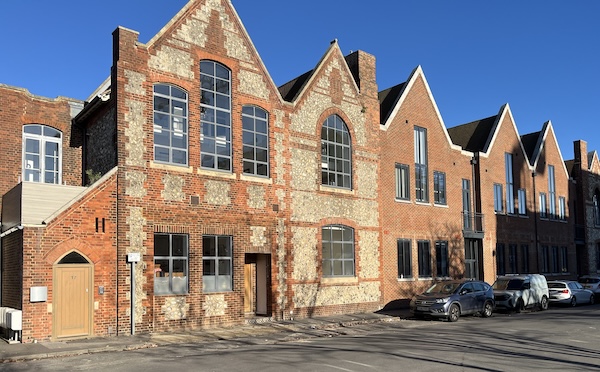
This striking block of flats stands opposite the Co-op in Ham Road. The building dates back to 1875.
For the most part, it is a sympathetic conversion. The east and west ranges are much as they were built. The middle ranges have been substantially remodelled, but still they take their cues from the Victorian building: sharply-pointed gables, three tall windows on the first floor, the red brick.
In 1841, Augustus Pugin published The True Principles of Pointed or Christian Architecture. His book kicked off the Gothic Revival. Pointed architecture is a good description of this school. The window on the first floor of the second bay is pointedly Gothic. Earlier photographs reveal the original middle ranges were pierced by a line of smaller Gothic windows.
Christian architecture, too. Because, like this school, many churches of the second half of the nineteenth century were faced with flint.
The reason why so many schools looked like churches was that they shared the same builder. By 1851, the Church of England had opened more than 17,000 National Schools.
But the school on Ham Road wasn’t built for the Church of England. It was built for The Shoreham School Board.
The Education Act of 1870 made the education of children up to the age of 13 the responsibility of elected School Boards. These Boards were set up in towns and cities across the country.
If the Shoreham Board School had been built ten years later, it might have looked very different. By then, the Queen Anne style had become the dominant style for Board schools: red brick, yes, but no more flint, and with flat-headed, white-painted sash windows instead of pointed windows. In Brighton, architect Thomas Simpson built nine schools in this style.
The later Board schools wanted to distinguish themselves from the Church of England schools by choosing an alternative to Gothic. Partly they wanted something less heavy – more child-friendly perhaps.
But it was also because these schools had to be non-denominational. By law, they could not teach the liturgy of one particular religion, as Church of England schools did.
The school was extended in 1907 to designs by Brighton architect Arthur Nye. His plans include a double classroom labelled “Marching Room”.
In far-away South African, the Boer War had ended in 1902 with the defeat of the British forces. It was thought that the average Tommy had proved themselves too physically unfit to perform their martial duties effectively.
So if you walk along Ham Road and hear the tramp of boots, it’s the ghosts of those schoolboys practising marching up and down.
Last modified: December 29, 2025